Total Pageviews

Monday, September 26, 2011

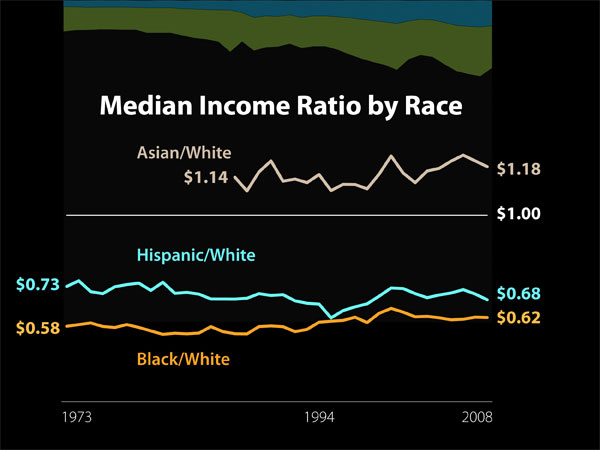
Check this out...

If your interested what this means, check out the website below.


Source: Census Bureau.
Chart by Catherine Mulbrandon of VisualizingEconomics.com.


http://www.slate.com/id/2266174/entry/2266214/fs/0//

Sunday, September 25, 2011

Is class position determined by Individualism or Socioeconomic Structures and Policies? We've already talked about this in relation to earlier topics but I'd like to directly name and discuss the very different arguments in the debate about the presence of class. And name the different policies.
“ The social distribution of wealth discloses a fresh formidable dimension of racial inequality “ Oliver & Shapiro

Mobility in terms of class positions within the United States is facilitated by factors such as economic or social capitals, which we spoke about in a previous class. Therefore, the class that a person is born into in plays a major part in the social class that a person will obtain throughout their life. The idiom "social class" initially “referred to groups of people holding similar roles in the economic processes of production and exchange, such as landowner or tenant, employer or employee.” Such positions in those economic processes then would match up to how much status, power etc. people had within their class (therefore classifying them into certain categories and social pecking orders). Yet today the categorization of social classes is not that simple, belonging to a social class generally accompanies perceptions of class identities and also strong views of generalizations of groups of people. Most often today social class is not distinguishable through clear cut definable boundaries

With the political claws taken away from the differentiation of social class one can also also argue that individuals have the number one role in determining their social class positions. We as individuals compete for jobs the same jobs, obtain power through social capital in open markets, and through personal actions attain higher statuses. Ye,t what those who argue this fact are not looking at is that they are seeing a whole different world than what is actually happening. Recently different policies have a major effect on class positions. Policies such education and welfare ( things like WICK for example), all influence social class. As a society the implication for having obtained help from the Government with things such as welfare, places people in certain class positions. Therefore because they receive a benefit from their Government they are branded a class automatically.  Racial and gender inequality play major roles in class positions (such a major role that I literally could write about this for every post this semester). Repulsive realities such as racial valuing of neighborhoods, and denied access to mortgages to black families all only prove the argument stronger that political fangs are deep rooted in the skin of this catastrophe we call individual freedom.
Sadly, many people may or may not be conscious of their membership in a certain class. They may categorize themselves as something they are or are not and that only leads to more confusion on how to distinguish class position, but it does not help us define whether it is due to individualism and or policies the best we could ot make this place actually equal for all. Being aware of your social class is extremely important in order to grow conscience of how you are being treated for being in that class and what you can do to change it

Tuesday, September 20, 2011

Who am I?

Your First Post:
Your first post should be a short introduction to you: who are you, how your semester is going so far, why are you in this class, what do you do when you are not in class, or what you think we should know about you and any initial thoughts or questions you might have on the subject of class. You will post the rest of the entries as they are due (see course syllabus for dates), or whenever you have something to say! 


Hey Everyone!

My name is Sara, and I am one of your classmates this semester. This is my second time using a blog for a class, and also my second masters level course at RIC. I am definetly excited to learn a whole bunch of new stuff especially because it has a bit of a controversial edge to it!  I think the topics we are going to talk about are going to be extremly useful in every situation we now approach in our lives, and I look forward to be more knowledgeable on such social issues. I am currently persuing a masters in Public Administration from the University of Rhode Island, and hopefully this course will be able to help me further my career in a positive direction !! 

TUESDAY, SEPTEMBER 6, 2011

Your first post assignment is to find something from today's news (text or video) that addresses the consequences of inequality. Post it and add your comments.


I really like this video. It's a bit long but the woman ( Kate) is speaking about the comparison quality of human life and social gradients amongst poor countries and wealthier countries. Though money is a huge factor of inequality I believe the gradients shown in the video truley show the social glue holding countries together is being stretched way too far and is basis of health and social problems each country has today.

What is the value of a class analysis? 9/20


"For this week's post, pull a quote or two from the articles and use that to discuss the value of a class analysis. Why should we bother with looking at the world, history, and our disciplines, through a class lens? What do we see differently? Is that important? How does this change your thinking? These should be substantive and draw on the texts."


History offers us information how people and societies as a whole behaved before we were there ourselves to witness anything. It is a wonderful thing because, solely relying on current information would diminish our efforts in attempt to try and mimic or most likely correct (or improve) previous histories inadequacies. The famous saying “History repeats itself” is one that rings very true for this history lesson. As a society the reconstruction of the past enables us to understand the present better, and therefore plan for our futures.

Furthermore, by the teachings of history we have the ability to learn about ourselves and how we can therefore identify in class terms compared to those of the past . After reading author Michael Zweig’s article in Chapter three a quote about history and class distinctions when dealing with inheritances in families really stood out for me ”The sad fact is that after a lifetime of work, most working class people have nothing to show for it, only their kids to take their place.” This is so sad but so true. Wages as explained throughout this article for the working class people fell and the wealth from the workers (which they earned keep in mind) was all but shifted to the capitalists (the big man on the totum pole...thats right mostly MAN). A true show of power distortion in America. Though these working class people worked their entire lives the people of power (the CEOS and Bill Gates of our society today), still get the big prize at the end. With no history of belongings (homes etc) its like the working class were pretty much robbed of their legacies. A sadness that is still true today in the year 2011.

A true-life story of these “working class” people’s histories being demolished was during hurricane Katrina that stuck New Orleans. Thousands lost homes, life savings, and everything they worked so hard to get. A truly catastrophic event that could have been avoided numerous ways, yet the wrong “class” of people did not live there in order for those problems to get fixed. A quote from the article which we read for class that truly made me upset was …so many of the people in the arena here, you know, were underprivileged anyway, so this—this (she chuckles slightly) is working very well for them.”

Where do these sick people come from?? People of power still think like this! AWFUL! A quote from Zweig again, “to exercise power, you need to know who you are. You also need to know who your adversary is, the target in conflict.” We need to know our history in order to find the people who have spoken such ill words like the previous quotes of Katrina’s victims. History allows us to find these wolves in sheep’s clothing, and actually try and do something about it…if we have power ourselves (by chance). The diminished histories of hard working people should be a fact of history, and not a re-occurance everyday still.