Total Pageviews

Sunday, November 27, 2011

journal entry # 4..teeth matter

Teeth, before and after braces
Which mouth do you like better?

While at work today, I was reminded of something Professor Schuster had told us about the connection between teeth and social status in America. When she said it I actually was really interested for her to talk a bit more on it, but I actually forgot to ask her. Yet today at work I pretty much got a “real life” answer of what my interests on the subject wanted to inquire further about.
While working with two of my co-workers a male customer walked in. The customer was a handsome man, and I commented on that to the other female who I was working with…then she disagreed. As the man left, I asked her why she did not think he was handsome, and her response was “ he had crack head teeth”, and I immediately thought of our class. 
Prior to this course, and our learning’s of social status factors, I would have never thought of the ever apparent relationship between socio-economic status and dental hygiene. Then, I thought about the issue a little further. Evidently, good teeth are a vain sign of wealth, and how well a person has the ability to take care f themselves. Things like normal biannual cleanings are covered by health insurance (which so many people today are without), but further procedures that go above and beyond (getting braces from an orthodontist, or a root canal from a surgeon) are probably not be covered in health insurance. Consequently if a person is without health insurance or cannot get braces because they cannot afford them, it is actually a very sad reality that this will predict .how they will be treated in their life….Sometimes when your eyes are opened to these sad realities it makes you embarrassed to be part of such a vain culture. It truthfully just feels bizarre that point was proven to me today. So bizarre that a person’s teeth can be such a huge social setback in their everyday lives with something important such as receiving a job, or as miniscule as being viewed as handsome or not by s couple of pizza shop girls.

Wednesday, November 9, 2011

Third Journal Entry

For this journal entry I was prompted by the title of a book a recently saw while I was looking up some interesting readings for this course. The title was called Limbo: Caught between blue collar roots with white collar dreams. That title alone had my mind thinking in a million different directions about how that statement rings true in my own life as a student, and also I believe for  other students as well. Assuming that for the most part all new college students experience a huge range of emotions in the unfamiliar school setting like I did, I think most students from working class families are more prone to be nervous. Wondering if they are smart or “capable” enough (like what we saw the single mother in the movie played in class go through) for what they are about to endure with school, and wondering if they belong at all. The transition can be much harder for working class students surrounded by middle class and upper class societal peers, because of one major reason being that they do not feel socially and cognitively prepared for the setting they were placed into. Feeling as though you are not “smart enough” or do not know enough as your peers is something I actually went through when I chose to attend URI for my Masters in Public Administration (MPA).


Because of gaps in previous education, there might be fairly basic material that students don't know and skills they don't have. That was certainly the case for me. I received my undergraduate degree in communications from RIC, and yes I thought I received enough education in that area to get me through life, but my knowledge of political issues, histories, policies, budgets etc. was so spare that I had fearful incomprehension every single time I started a new class with my masters program.  I felt like I was the only person in the room that was going through this transition, because it seemed like everybody in my program had graduated from elite schools for their undergrad’s, or had a history of professional backgrounds that went side by side with what we were being taught in the public sector field of our state and other states.

Along with not being completely aware of the materials we were studying, I had completely different strategies than most of the other MPA students when it came to studying or writing papers for our classes. All throughout my time at RIC I was with kids who just like me, came from working class backgrounds, we studied the same, we dressed very similar, and surprisingly we all had comparable backgrounds (I also was in the same major as my brother and two cousins, plus my other brother and sister took classes in my building so it was like a family for me at RIC). We all had similar note taking strategies and highlighted in our notebooks what we thought was important for the tests, and one maybe out of every 20 students in a class had a lab top to take notes on. Yet, in the MPA program everybody had laptops to take their notes on, and those notes aren’t bulleted lists like I was used to the Professor organizing for me. They are of thoughts and ideas now, they are no longer something I can underline and memorize the day before to pass the exams, and they require me to think about the theory or idea that was being presented and talk about it on paper or even aloud to my fellow peers. This was completely different for me! I had such a difficult time because I wanted to just regurgitate what I thought the teacher had said and I would pass the test with flying colors. Well, I was wrong.
I also found some research recently while reading again for this course that some working-class students are hesitant to ask questions, fearful of seeming unintelligent. Yes, these reservations are not held solely by working class students, but I know I went through this when I knew I had come from a working class background and my other peers had not. Yet over the year I learned the skill of asking a question the right way without sounding like you are completely dumb, which I believe is a defensive skill. Phrasing my questions with a part of the discussion that I do understand, and asking how it relates to what we are talking about in the literal sense is an example of this which I would never do previous to entering this program. Asking a question when you are with “people who are like you” is like second nature, yet when you are around people who you feel are “smarter” than you, your learned behaviors and culturally influenced strategies on how you learn is something you use as defense mechanisms and strategies on how your deal with every situation.  Our class backgrounds really do affect so many aspects of our lives, and it’s how we personally can cope with it in order for us to succeed in what we want to do.

Tuesday, November 8, 2011

Are these people feeling what women have felt for years?

http://news.yahoo.com/video/featured-24306389/remake-america-income-inequality-27188238.html

Check this out!

The Wage Gap Exists Within Racial/Ethnic Groups

"White men are not the only group that out-earns women, although the wage gap is largest between white men and white women. Within other groups, such as African Americans, Latinos, and Asian/Pacific Islanders, men earn more than women (Source: U.S. Census Bureau). " A quote and picture representation from an article titled The Gender Wage Gap: Debunking the Rationalizations
Gender Wage Gap by Ethnicity

Ladies! Does this make you as angry as this makes me??
by: Hilary M. Lips, Radford University

Tuesday, November 1, 2011

Bringing our class home

Second Journal Entry!
Most likely the first thing that comes to our minds when we think of what it means to be in a upper or lower class societies is the financial status’ of the two groups. Yes, upper class societies are generally wealthier, and lower class societies tend to be less wealthy. This I knew before taking this course, which many people probably do as well. However, last class we spoke briefly about the values and characteristics of what some scholars believe go hand in hand with particular social classes. I was extremely intrigued by this. I thought the examiners who came up with the certain characteristics and values hit the nail on the head to be honest. Though some others in our class did not feel that all of the characteristics were dead on, I truly did, and I thought it was a very interesting way to examine the different social classes in that respect rather than just with money as it always is.
With that said, I brought the hand outs with the compared values to my family to take a look at, to see if they agreed with me. They did agree as well, and I actually made a copy for my Nana because she said the handouts actually answered a lot of questions she had for her daughter who she feels “married above her class”. (I am not sure if you remember but in class I briefly spoke about this family member who was told by their father that they could not associate with their cousins when they came to RI for college). I would love to actually show those family members the two comparisons to see what they thought of the different values listed to see if they agreed, but my Nana asked me not to since it may seem like I am starting “trouble” with the family so I have to listen (a value listed for the working class of the patriarchal system).
It is clear that each class appears to feel more comfortable surrounded by individuals in the same situation, and this may not be wrong for each class to do this. Yet, many of these comparison fuels thoughts of what the distinctions between the classes means to us and how do these differences influence our behavior? I think that by seeing these differences, in my Nana’s case it may answer questions she had as to why her daughter acts differently from her other children who married spouses with similar class background may be a good thing but it may also be a detriment as well. Like many other occurrences in life, once something is labeled and given a direct characteristic for example opinions are then able to be formed good or bad, and it is inevitable for this to happen. IT is no longer something that people cannot put their finger on to be specific enough about the differences, nut it makes the differences more real and in our faces.  There are actually papers, documentaries, studies etc. that have been performed on this subject and now it is something that feeds each class into forming opinions about the other, only fueling more separation amongst the classes..I don’t know if these distinctions are good to know or a harm at the same time.


Monday, October 24, 2011

Journal Entry #1

 First Journal Entry!


What is happening with Occupy Wall Street?

I have been out of the country for the past two weeks, and while I was away I turned to the only English speaking news station at night time to catch up on the news. From what started out to be a small protest when I left, Occupy Wall Street has turned into a huge movement that has gained national coverage. It is being talked about in the little coffee shops of Greece, and people are proud of the Americans for “showing some passion for once” a quote from an 85 yr old Greek man I met.

Although many are proud of what is going on, since there is not actually one real demand that is out there there are many folk who believe that is the reason why the protests are worthless.  Yet, I am going to try and provide here the answer to why you are wrong. Specific demands have not been enacted for the simple reason that it would be pointless to make those directed demands until the movement has become stronger in the political arena. Instead, occupiers have chosen to make their demand the occupation itself, and the direct democratic state occurring…which may or may not come up with some specific demand…which is OK.

 This position of “OK” is actually a fantastically powerful statement for what Wall Street Occupiers have come to represent. This goes against what all of us have grown up thinking we should do in order to be heard. 1.Know the issue  2. Formulate a plan of attack 3. Attack…Yet, since truth of what the issues are of the REAL problems is often too much to ask of the American mass media, the question of demands has turned into an enormous PR question.. Which I think is brilliant.


Numerous people I know, and even those while I was in Greece asked me, because I was American, what is the point? Who are the organizers, is there any type of organization? They look for that step by step recipe they are accustomed to. They are used to group being formed with a charismatic celebrity spokespersons (the organizers supposedly), trendy slogans and advertising occurs, and lists of resolutions, or demands are compiled .These “organized” groups do a little research host little lobbies, gain some press, and always have a few specific people that speak to the media  for exposure. It is the number one formula embedded in people's minds as how things should be done or problems should be solved.

Historic movements that have changed unequal human states, influenced governments and societies to modify directions are people based, movements. Movements where people demonstrate through their actions as a mass that  they will no longer be silent and as a mass they will overturn what  has occurred. They no longer can be ignored because they are out in the open, and with determination they do make change.  Look at the freaking 1960’s people!

News reports (even in Greece) have been calling the protesters nonspecific, yet in a world as complex as ours, we’re all uninformed about most things! Yet, being aware of the wealth from Wall Street and its huge influence in politics does not require a comprehensive knowledge of what stock trading is or a masters degree in finance. Everyone in the movements come with their own way of thinking of “people before profits”.  Yes, a variety of other issues varying from ending the wars, to affordable healthcare, to more welcoming immigration policies have arisen so it can be confusing. I get that. However these issues are all at some level interconnected, and why not protest for all of the other disparities that is wrong with our Government if you are out there already? Why does it have to only be one specific issue per protest? The answer is seriously as simple as that! As word spreads, the crowd has been getting older, more diverse and everybody’s demands have been different which is OK once again.

One thing that is certain with this movement is that hope for a better world for us to live in is there. These occupiers deserve to be taken sincerely by all; they are contesting for what we have complained about within closed doors. PEOPLE oriented movements such as Occupy Wall St have messages that are very clear if people decide to actually listen.

Tuesday, October 4, 2011

Food for thought on Education and Class

Check out this interactive "how class works" site put together by the NY Times, I thought it was interesting and wanted to share them with you fellow social class enthusiasts!


http://www.nytimes.com/packages/html/national/20050515_CLASS_GRAPHIC/index_02.html

Readings - Anyon, Gorski, Laureau, Engel.


Consider your own experiences as you read this week. Pick a quote and / or main idea from two texts as a way to examine and consider your own educational experiences from a class lens. This reflection on your own schooling should not be a telling of stories but a substantive discussion.
 
Educational experiences through a class colored lens are considerably different for each individual in the US. As we have looked at before, the higher regarded class somebody is in, the better they are off when it comes to pretty much anything in their daily lives ( either as small as being served at a coffee shop differently or something as big as education offered to them). 
 
Though there are many ways to describe a person’s class, the top four distinctions come from education, wealth, occupation, and income, and each one of those distinctions is prompted by the other.  Therefore explaining why resources made available to those of the middle and upper classes has a unfaltering advantage when choosing an educational path. Though all Americans have great expectations of their schools and we tend to invest them with the primary responsibility for providing our children with the means by which they may succeed in an increasingly uncertain work world, this unfortunately cannot be fixed by schooling because it only fosters social classes even further.   
 
Schools most definitely reinforce social class  in their curriculums, and I first hand have seen this occur. For example, I attended a private high school in Providence RI, well known for its prestige. The majority of students (excluding myself and my brother), are from the top social classes because of the money or occupations their parents hold. My cousins (same middle/working class as my family), attended East Providence High School. The differences when comparing the curriculums and classes offered between my cousins and myself were vast.   Though we both had the same basic classes (English, math, gym).  East Providence offered vocational studies to its students, and my private school did not and never will. Maybe I am jumping to conclusions here about fostering the working/middle class, but does that not set up the students for careers with no mobility to move up in their class?...I don’t know the answer… Yet again, my cousins who attended that vocational program loved it and were happy to go to school and , and prepare themselves for the career that they do today. I don’t know what the real problem is, the fact that schools reinforce social class with those types of programs, or are the just reinforcing to make students stay interested? This one example only fuels the argument which Bourdeua made that certain schooling curriculums are different in skills leading to “social power and regard (medical, legal, managerial) are made available to the advantaged social groups but are withheld from the working classes to whom a more "practical" curriculum is offered (manual skills, clerical knowledge.” How schools prepare students for further education and jobs,  plays a big role in the classes offered…


Monday, September 26, 2011

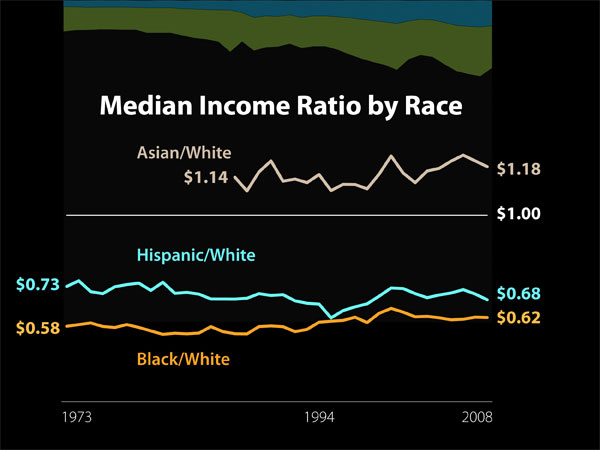
Check this out...

If your interested what this means, check out the website below.


Source: Census Bureau.
Chart by Catherine Mulbrandon of VisualizingEconomics.com.


http://www.slate.com/id/2266174/entry/2266214/fs/0//

Sunday, September 25, 2011

Is class position determined by Individualism or Socioeconomic Structures and Policies? We've already talked about this in relation to earlier topics but I'd like to directly name and discuss the very different arguments in the debate about the presence of class. And name the different policies.
“ The social distribution of wealth discloses a fresh formidable dimension of racial inequality “ Oliver & Shapiro

Mobility in terms of class positions within the United States is facilitated by factors such as economic or social capitals, which we spoke about in a previous class. Therefore, the class that a person is born into in plays a major part in the social class that a person will obtain throughout their life. The idiom "social class" initially “referred to groups of people holding similar roles in the economic processes of production and exchange, such as landowner or tenant, employer or employee.” Such positions in those economic processes then would match up to how much status, power etc. people had within their class (therefore classifying them into certain categories and social pecking orders). Yet today the categorization of social classes is not that simple, belonging to a social class generally accompanies perceptions of class identities and also strong views of generalizations of groups of people. Most often today social class is not distinguishable through clear cut definable boundaries

With the political claws taken away from the differentiation of social class one can also also argue that individuals have the number one role in determining their social class positions. We as individuals compete for jobs the same jobs, obtain power through social capital in open markets, and through personal actions attain higher statuses. Ye,t what those who argue this fact are not looking at is that they are seeing a whole different world than what is actually happening. Recently different policies have a major effect on class positions. Policies such education and welfare ( things like WICK for example), all influence social class. As a society the implication for having obtained help from the Government with things such as welfare, places people in certain class positions. Therefore because they receive a benefit from their Government they are branded a class automatically.  Racial and gender inequality play major roles in class positions (such a major role that I literally could write about this for every post this semester). Repulsive realities such as racial valuing of neighborhoods, and denied access to mortgages to black families all only prove the argument stronger that political fangs are deep rooted in the skin of this catastrophe we call individual freedom.
Sadly, many people may or may not be conscious of their membership in a certain class. They may categorize themselves as something they are or are not and that only leads to more confusion on how to distinguish class position, but it does not help us define whether it is due to individualism and or policies the best we could ot make this place actually equal for all. Being aware of your social class is extremely important in order to grow conscience of how you are being treated for being in that class and what you can do to change it

Tuesday, September 20, 2011

Who am I?

Your First Post:
Your first post should be a short introduction to you: who are you, how your semester is going so far, why are you in this class, what do you do when you are not in class, or what you think we should know about you and any initial thoughts or questions you might have on the subject of class. You will post the rest of the entries as they are due (see course syllabus for dates), or whenever you have something to say! 


Hey Everyone!

My name is Sara, and I am one of your classmates this semester. This is my second time using a blog for a class, and also my second masters level course at RIC. I am definetly excited to learn a whole bunch of new stuff especially because it has a bit of a controversial edge to it!  I think the topics we are going to talk about are going to be extremly useful in every situation we now approach in our lives, and I look forward to be more knowledgeable on such social issues. I am currently persuing a masters in Public Administration from the University of Rhode Island, and hopefully this course will be able to help me further my career in a positive direction !! 

TUESDAY, SEPTEMBER 6, 2011

Your first post assignment is to find something from today's news (text or video) that addresses the consequences of inequality. Post it and add your comments.


I really like this video. It's a bit long but the woman ( Kate) is speaking about the comparison quality of human life and social gradients amongst poor countries and wealthier countries. Though money is a huge factor of inequality I believe the gradients shown in the video truley show the social glue holding countries together is being stretched way too far and is basis of health and social problems each country has today.

What is the value of a class analysis? 9/20


"For this week's post, pull a quote or two from the articles and use that to discuss the value of a class analysis. Why should we bother with looking at the world, history, and our disciplines, through a class lens? What do we see differently? Is that important? How does this change your thinking? These should be substantive and draw on the texts."


History offers us information how people and societies as a whole behaved before we were there ourselves to witness anything. It is a wonderful thing because, solely relying on current information would diminish our efforts in attempt to try and mimic or most likely correct (or improve) previous histories inadequacies. The famous saying “History repeats itself” is one that rings very true for this history lesson. As a society the reconstruction of the past enables us to understand the present better, and therefore plan for our futures.

Furthermore, by the teachings of history we have the ability to learn about ourselves and how we can therefore identify in class terms compared to those of the past . After reading author Michael Zweig’s article in Chapter three a quote about history and class distinctions when dealing with inheritances in families really stood out for me ”The sad fact is that after a lifetime of work, most working class people have nothing to show for it, only their kids to take their place.” This is so sad but so true. Wages as explained throughout this article for the working class people fell and the wealth from the workers (which they earned keep in mind) was all but shifted to the capitalists (the big man on the totum pole...thats right mostly MAN). A true show of power distortion in America. Though these working class people worked their entire lives the people of power (the CEOS and Bill Gates of our society today), still get the big prize at the end. With no history of belongings (homes etc) its like the working class were pretty much robbed of their legacies. A sadness that is still true today in the year 2011.

A true-life story of these “working class” people’s histories being demolished was during hurricane Katrina that stuck New Orleans. Thousands lost homes, life savings, and everything they worked so hard to get. A truly catastrophic event that could have been avoided numerous ways, yet the wrong “class” of people did not live there in order for those problems to get fixed. A quote from the article which we read for class that truly made me upset was …so many of the people in the arena here, you know, were underprivileged anyway, so this—this (she chuckles slightly) is working very well for them.”

Where do these sick people come from?? People of power still think like this! AWFUL! A quote from Zweig again, “to exercise power, you need to know who you are. You also need to know who your adversary is, the target in conflict.” We need to know our history in order to find the people who have spoken such ill words like the previous quotes of Katrina’s victims. History allows us to find these wolves in sheep’s clothing, and actually try and do something about it…if we have power ourselves (by chance). The diminished histories of hard working people should be a fact of history, and not a re-occurance everyday still.